The Seed and the Sky: What Ghana's 2027 Budget Really Means for Farming and Climate
Ghana’s 2027 Budget sets out a US$3 billion commercial agriculture plan for 2027–2030. What could its local purchasing, irrigation and energy proposals mean for farmers’ incomes, climate resilience and food prices?
- Commercial agriculture gets US$3 billion over 2027 to 2030, the largest pillar of the US$10 billion New Economy programme.
- The Ministry of Food and Agriculture receives GH¢2.88 billion in government funds. That is about 0.77 percent of total 2027 spending, against a 10 percent AU commitment.
- The Budget does not say how much of the GH¢30 billion New Economy money goes to agriculture in 2027.
- Public institutions will be required to buy only Ghanaian-grown food. Rice import licences will be tied to local purchases from 2027, and commercial rice imports banned by 2030.
- All cocoa is to be processed locally by 2030, with at least 50 percent by 2028.
- The Budget expects El Niño to reduce cocoa output, yet climate is not listed as a fiscal risk and there is no agricultural adaptation or emergency fund.
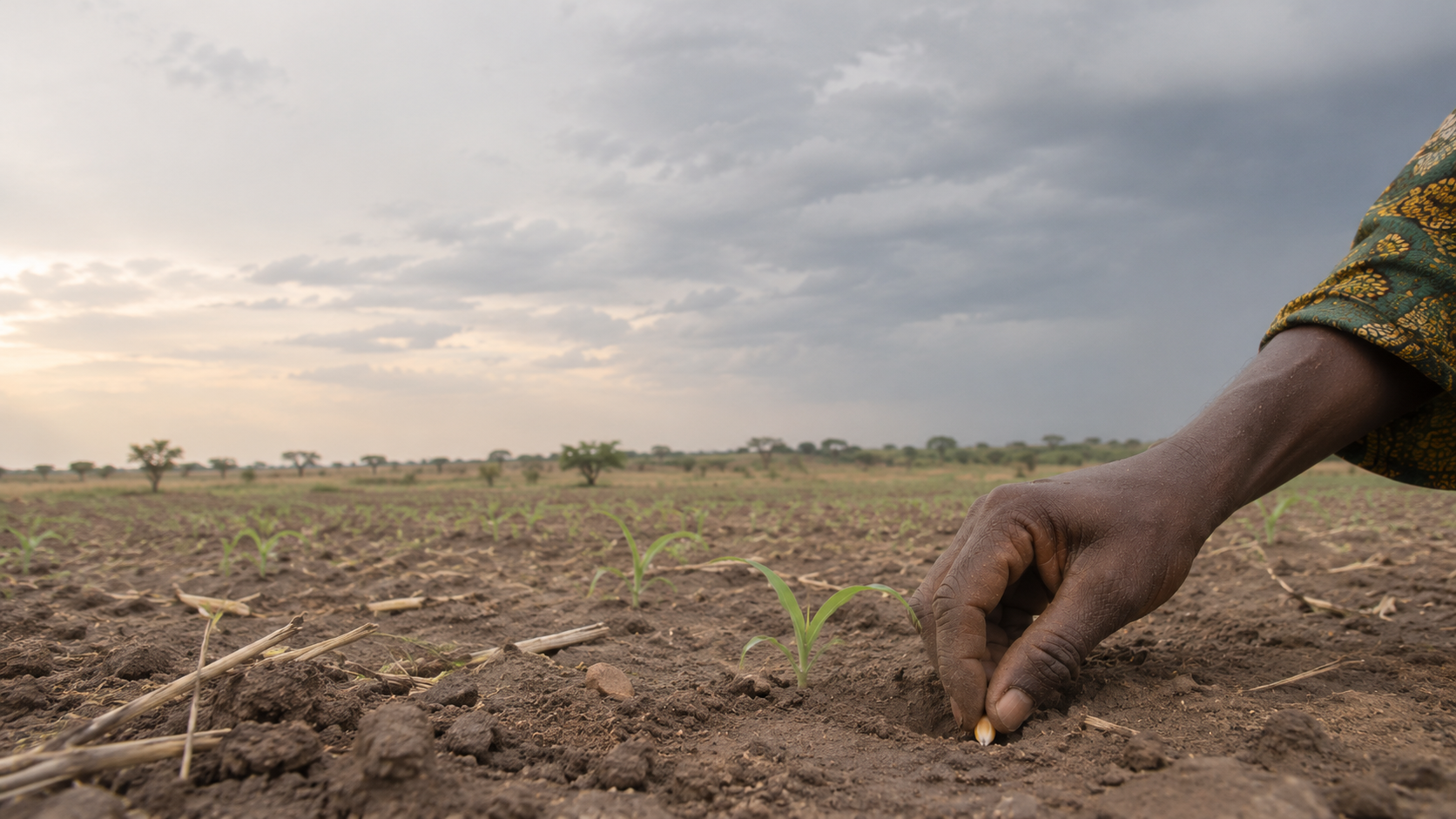
Every farmer in Ghana is a forecaster. Before a single seed goes into the ground, she has already made a bet on three things she cannot control: when the rains will come, whether the fertiliser will arrive, and whether anyone will pay a fair price when she harvests.
On Thursday evening, the Finance Minister stood in Parliament and made his own bet. The 2027 Budget, which he called "The New Economy", wagers that Ghana can stop importing what it can grow, start processing what it grows, and turn farming from a way of surviving into a way of doing business. He put a number on it: US$3 billion for commercial agriculture over four years, the largest single pillar of a US$10 billion programme.
I have spent more than a decade working with farmers, agribusinesses and the banks that lend to them. I analysed the Budget Statement with one question in mind: if I were a farmer, what would actually change for me in 2027?
My answer is this. The Budget gets the market right, it gets the money only half right, and it leaves the weather almost entirely to chance. Let me explain why.
Start with the money
Budgets are easier to understand when you shrink them. Government plans to spend GH¢375 billion in 2027. Imagine it as GH¢100 instead.
About GH¢28 of that GH¢100 pays the people who work for the state. Roughly GH¢26 builds things: roads, hospitals, power plants. About GH¢16 goes on interest for money Ghana borrowed in the past. And the Ministry of Food and Agriculture, the ministry that speaks for the people who feed us, receives less than one cedi.
That number deserves to sit with us for a moment. MoFA's government allocation for 2027 is GH¢2.88 billion. That is about 0.77 percent of total spending. Under the African Union's Maputo and Malabo commitments, Ghana pledged to spend 10 percent of its budget on agriculture. Farmer groups asked for exactly that before Thursday. They did not get it.
But the honest answer is more complicated than one bad number. Some of the money that matters most to farmers sits outside MoFA. GH¢3 billion will extend rural electrification. GH¢29.8 billion goes to the Big Push road programme, including GH¢2 billion for a project to connect markets. And the US$3 billion Commercial Agriculture pillar of the New Economy is funded separately from MoFA's budget.
Here is the catch. Government will put GH¢30 billion into the whole New Economy in 2027, but the Budget does not say how much of that goes to agriculture next year. If farming got its fair share, about 30 percent, agriculture would be closer to 3 percent of the Budget. That is my own estimate, not a government figure, and it is still far from 10 percent.
There is one more detail most people will miss. About a fifth of MoFA's total 2027 resources, roughly GH¢701 million, comes from foreign loans and grants. Ghanaian agriculture is still partly paid for by development partners.
The big bet: from growing food to selling it
For years, Ghana's farm policy has asked one question: how do we help farmers grow more? This Budget asks a better one: who will buy what they grow?
Anyone who has stood in a market in August knows why that matters. When the harvest comes in, everyone sells at once. Prices collapse, produce rots in sacks, and the farmer who borrowed to plant loses money on a good harvest. The Budget Statement says it in a single line I wish every policymaker would memorise: "Production without storage creates gluts and losses."
So the 2027 Budget pulls on the market side, hard. Four measures stand out.
Public money will buy Ghanaian food. The government will amend the procurement law so schools, hospitals, and other public institutions can use public funds only to buy food grown in Ghana. The Minister's line will be quoted for years: "if you use Ghana's money to buy rice, you must buy Ghana rice!" With GH¢2.1 billion going to school feeding alone in 2027, this could become the most reliable buyer many smallholders have ever had.
Imports will have to make room. From 2027, rice import licenses will be tied to purchases from verified Ghanaian farmers and millers, and commercial rice imports are to be banned by 2030. Sugar will get import permits and quotas that shrink as local output grows.
Raw cocoa exports will end. At least half of Ghana's cocoa is to be processed at home by 2028, and all of it by 2030, after which raw bean exports will stop. The Minister's argument is simple: "the country that grows the bean must retain a far greater share of the industry built around it."
Storage gets real money. GH¢500 million for silos and GH¢200 million for the National Food Buffer Stock Company give farmers somewhere to sell when prices fall.
Behind these measures sit eight agro-industries, each meant to have its own plan, financing and delivery team: rice, sugar, poultry, maize and soya feed, fish farming, oil palm, vegetables and cocoa. Some of the financing is thoughtfully designed. Oil palm, for instance, gets a US$500 million World Bank window with a five-year moratorium, because, as the Budget rightly notes, a tree crop cannot be financed like short-cycle trading. Poultry and feed farmers will draw on at least 40 percent of the Ghana EXIM Bank levy from 2027.
This is the strongest part of the Budget, and I want to give credit where it is due. It treats farming as a value chain, not a planting season.
It also carries risk. Import bans work only if local supply is ready, at a quality and price consumers accept. If rice hubs or sugar estates are late, quotas could push up prices for the very households this Budget wants to protect. The sequencing has to be right.
Back at the farm gate
Grand plans meet reality on a small plot, usually in March, when a farmer is waiting for inputs.
On paper, 2027 looks better. MoFA has GH¢515 million for fertiliser and certified seed and plans to distribute 79,900 tonnes of fertiliser. That is more than double the 36,506 tonnes it distributed in 2026. GH¢800 million will buy machinery for 50 Farmer Service Centres, where farmers should be able to hire tractors and planters. And the Feed Ghana Brigade of extension officers will grow. Today there is roughly one officer for every 768 farmers, which is a real improvement on one for every 1,567 two years ago, but still well short of the recommended one for every 500.
Now the harder truth. In 2026, construction began on only 10 Farmer Service Centres; the Budget now funds 50. Last year's fertiliser distribution under Feed Ghana did not start until mid-June, deep into the planting season, according to reporting at the time. And in June, MoFA and the Finance Ministry publicly disagreed about how much of MoFA's 2026 budget had actually been released: the Finance Ministry said 85 percent, MoFA said 12.4 percent.
That dispute tells you everything about the real risk in this Budget. A bag of fertiliser in March and a bag of fertiliser in July are not the same thing. One feeds a crop; the other feeds regret. Yet the 2027 Budget sets no dates for when seed and fertiliser will be procured and makes no commitment to publish MoFA's releases every quarter so farmers, lenders and the public can see whether money is moving.
The Budget does promise that every New Economy commitment will be "budgeted, authorised and transparently reported." I would ask government to apply the same standard to MoFA, and to start before the 2027 rains.
The weather is the missing line
If you ask farmers in the north or the transition zone what worries them most, many will not say fertiliser or prices. They will point at the sky.
The Budget knows this. Buried on page 80 is a sentence that should have been on page one: the anticipated decline in cocoa production "due to the effects of El Niño". Farmer groups have warned of severe dry conditions from November 2026 to April 2027. And this year we watched floods in Greater Accra and elsewhere displace families and force government to move GH¢226 million into emergency flood control.
Yet when the Budget lists the risks that could knock 2027 off course, it names commodity prices, tax leakages, the wage bill and court judgements. Climate is not among them. There is no fund to help farmers recover from drought, no crop insurance scheme for smallholders, and no emergency input support if the rains fail. The national Emergency Disaster Management Fund gets GH¢100 million, for the whole country and every kind of disaster.
That is the gap I would most like Parliament to close during the Budget debate.
To be fair, the green side of the Budget has real substance, and some of it will reach farmers directly.
Solar is about to get cheaper. Solar panels and batteries will be exempt from import duty and VAT. This is, to my mind, the single most farmer-friendly line in the entire Budget, even though it sits in the tax section. The Minister spoke directly to farmers, urging them to put Ghana's sunshine to work on their farms. A solar pump for dry-season vegetables, a solar dryer for maize, a small cold room for tomatoes: all of these should now cost less.
Galamsey damage gets serious money. GH¢400 million goes to reclaiming land destroyed by illegal mining, and GH¢200 million to the anti-galamsey taskforce, which promises to move from occasional raids to permanently denying miners access to rivers and forest reserves. For cocoa and food farmers whose land and water have been poisoned, this matters.
The coast gets protection. Over GH¢1.4 billion is set aside for sea defences at Keta, Blekusu and other coastal communities, which matters to fishing families.
Climate finance is being prepared. Government is building a Green Finance Taxonomy, has updated its Climate Prosperity Plan, and is preparing a Ghanaian institution to receive money directly from the Green Climate Fund. These are the foundations for bringing climate finance into agriculture, though the Budget does not yet attach any amounts to farming.
On energy, the picture is mixed. The Budget plans a state-owned 600 MW solar plant with 2,000 MWh of battery storage. It also plans a state-owned 1,450 MW gas-fired plant. Gas will remain the backbone of Ghana's power for years to come. That may be the pragmatic choice for a country that needs cheap, reliable electricity for factories and irrigation, but it is worth saying plainly: this is a transition budget, not a green budget.
One more figure stayed with me. The Tree for Life programme, which planted 22.24 million seedlings in 2026 against a target of 30 million, receives just GH¢20 million for 2027. For a country fighting deforestation and losing forest cover to galamsey, that is a small sum for a very large job.
What I would tell a farmer, and what I would ask government
A budget is a promise written in numbers. Whether it becomes real depends partly on government and partly on how well farmers position themselves to use it.
If I were advising a smallholder this week, I would say three things. First, get registered with your district agriculture office and join a registered farmer group or cooperative. Subsidised inputs, machinery services and big buyers like school feeding caterers all work best through groups. Second, ask early, before February, when Feed Ghana inputs will reach your district, and keep asking. Third, if you have been thinking about solar irrigation or a solar dryer, wait for the duty and VAT exemption to take effect, then ask suppliers for the new price.
To government, I would put four questions before the Budget is passed:
- How much of the GH¢30 billion New Economy money for 2027 will actually go to agriculture, and to which value chains?
- When exactly will 2027 seed and fertiliser be procured and delivered, and will MoFA publish its releases every quarter?
- What will protect farmers if El Niño hits as forecast: an emergency input fund, weather insurance, or something else?
- How will the "buy Ghana" procurement rule work for small farmers, not only for large suppliers?
These are not hostile questions. They are the questions that decide whether a good plan reaches the farm.
The seed and the sky
I came away from this Budget more hopeful than I expected to be. For the first time in a long while, a Ghanaian budget talks about farming the way a business owner would: who buys, who stores, who processes, who lends, and on what terms. That shift in thinking is worth defending, whoever is in government.
But a farmer's year is decided by two things above all: the seed, and the sky. The 2027 Budget has done more for the first than the second. It promises more seed, more fertiliser and better markets. It does far less to protect the people who will plant that seed under an increasingly unpredictable sky.
At SAIGE Africa, we will follow this Budget through the 2027 farming season, from the first bag of fertiliser to the last bag of maize sold, and report what we find. Ghana's farmers have been patient for a long time. They deserve a budget that arrives on time.
SAIGE Africa. Growing Africa's Agribusiness. From the Ground Up.
Sources: The Ministry of Finance, The New Economy, New Ghana, Jobs and Prosperity: 2027 Budget Statement and Economic Policy (12 November 2026), including paragraphs 246 to 337 (New Economy and Commercial Agriculture), 834 (El Niño), 866 to 875 (solar exemption), 907 (EXIM levy), 1025 to 1041 (fiscal risks), 1143 to 1145 (climate finance), 1191 to 1198 (MoFA delivery), 1226 (Tree for Life), 1299 (flood control), 1539 to 1591 (allocations) and Appendix 4A.
SAIGE Africa (2026). The Seed and the Sky: What Ghana's 2027 Budget Really Means for Farming and Climate. F. D. Nabong. saigeafrica.org
Founder and Executive Director of SAIGE Africa.